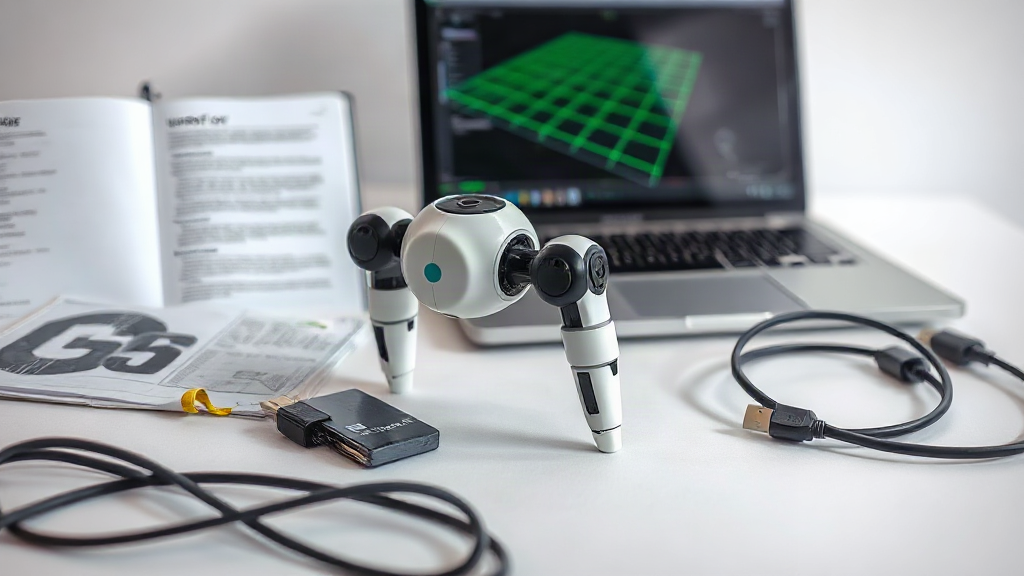
NVIDIA published a Sim2Real tutorial on Hugging Face that adds local obstacle avoidance to Pollen Robotics' Microduck while leaving the robot's existing walking policy unchanged. The tutorial trains a separate controller in NVIDIA Isaac Lab that adjusts gamepad velocity commands before they reach the walking policy. It is a follow-up to the Microduck walking tutorial and covers simulation training, evaluation, export and real-robot deployment.
A walking policy can keep Microduck balanced, but the tutorial's introduction says it does not tell the robot how to steer around an obstacle in its path. A social-media summary of the release, posted by the account @sandeeptole_03 on Instagram, repeats the workflow's main claims and points to the Hugging Face tutorial for full documentation.
Gamepad commands pass through a separate avoidance layer
An operator chooses a direction with a gamepad. The avoidance controller, trained as a separate model, modifies that velocity command before it reaches the walking policy. The tutorial's summary line reads:
"Add local obstacle avoidance to Microduck while keeping its walking policy fixed."
The first Microduck tutorial covered balance and gait. The follow-up adds the steering layer that decides how the robot moves around an obstacle.
An 8x8 time-of-flight grid feeds the controller
The controller takes time-of-flight (ToF) sensing as input. According to the social-media summary, it processes input from the robot's 8x8 ToF sensor grid and adjusts velocity commands on the fly. The post says this lets the robot steer around obstacles such as boxes and cones in real time.
The tutorial says Newton simulates both the physics and the sensor's depth measurements. It models ToF sensing with Newton's raycaster, so the training environment produces depth data of the kind the robot's sensor reports.
Thousands of parallel simulations train varied courses
NVIDIA Isaac Lab, which the tutorial describes as an open-source framework, provides the robot-learning environment. It trains policies across thousands of GPU-parallel simulations.
Training uses courses with varied obstacle layouts rather than a single fixed course. The courses are built from reusable SimReady assets, so the same asset library can be rearranged into different layouts.
Five steps from simulation to the real Microduck
The tutorial lists the published workflow in this sequence:
Build varied obstacle courses from reusable SimReady assets.
Model ToF sensing with Newton's raycaster.
Train the avoidance controller in Isaac Lab to adjust gamepad velocity commands around obstacles.
Evaluate the trained controller in simulation.
Export the navigation model and deploy it to the real Microduck.
The first four steps run in simulation. The last step moves the workflow onto hardware.
ONNX export for supervised gamepad runs
The deployment path exports the navigation model to the ONNX format. The social-media summary says the exported model can run on a local machine and augment the robot's physical movement during supervised gamepad operation.
The post presents the workflow as a documented path for developers to add perception-driven skills to small-scale robotics. The Microduck is the platform the tutorial uses, and the export and real-robot deployment steps are its final stages.